Handyman and Property Care on Crane Island
Crane is a quiet, walk-everywhere island tucked between Orcas and Shaw. It is one of the shorter runs I make and one of the emptiest places I work.
- Licensed & bonded
- WA L&I #SANJUJI741OT
- Insured
- Locally owned in Friday Harbor
Through Wasp Passage and Pole Pass
Crane sits just off the southwest shore of Orcas, between Orcas and the northwest corner of Shaw, with Deer Harbor across the water. It is about five nautical miles from Friday Harbor as the crow flies and maybe seven the way I run it, north up San Juan Channel and west through Wasp Passage. That makes it one of the shortest crossings on my list, which is good news for anyone paying for a boat day.
The community dock is on the island's north end near Pole Pass. Pole Pass is narrow and the current through it is not something to be casual about in a small boat, so I time the approach rather than just aiming at the gap. The Washington State ferry passes to the south through Wasp Passage on the Orcas run, which means summer wake traffic is a factor at the dock.
Once ashore, Crane is a walking island of about 236 acres. No public services, no store, no commercial anything. There is a private grass and gravel airstrip of roughly 1,500 feet, limited to residents, with a well-known crosswind problem — a commuter operator publicly restricted the aircraft it would send there after a 2022 landing overrun. I mention it because owners sometimes assume a contractor can fly in with material. On Crane, no.
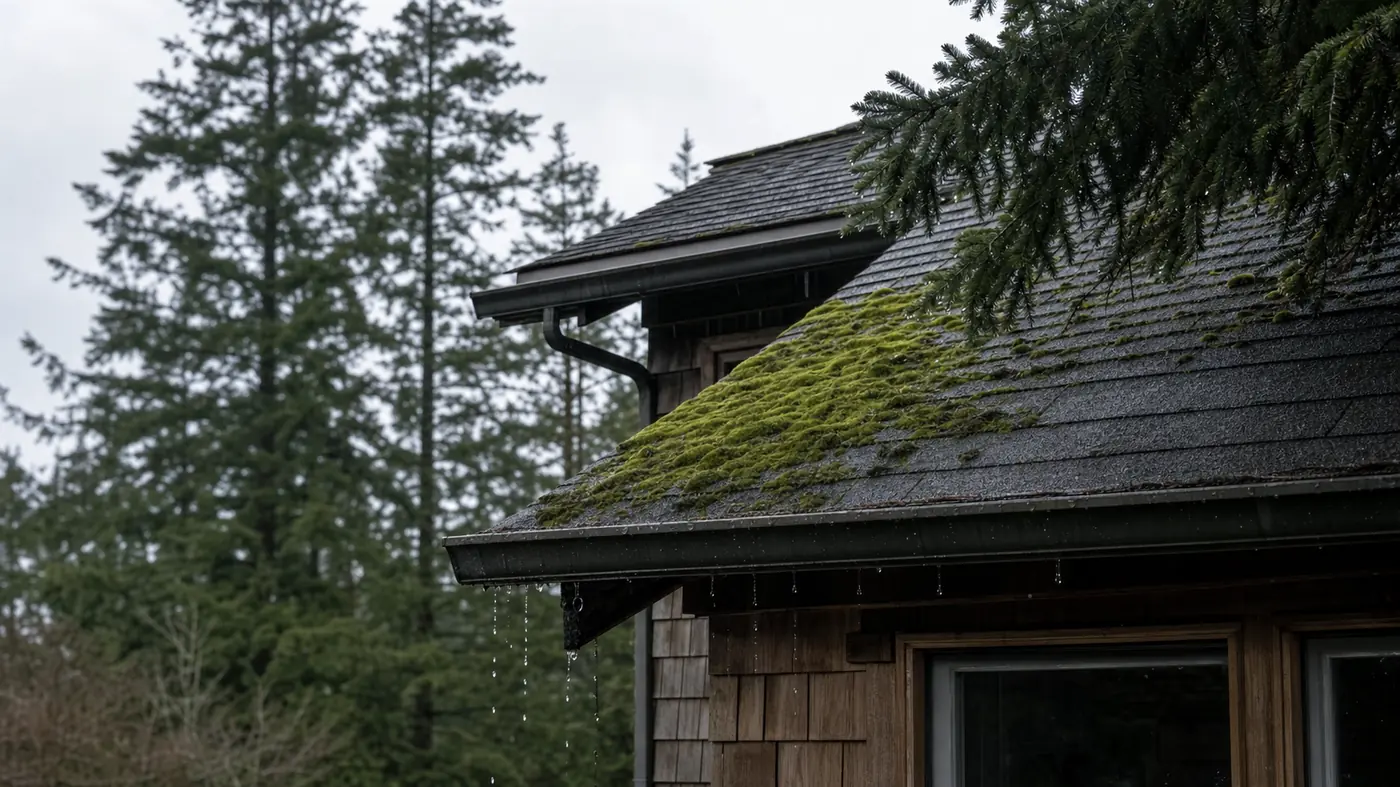
Shoreline houses under trees
Crane was subdivided starting around 1960 and most of the houses ended up near the shoreline, which is the whole point of the island. There is also a resident-run nature preserve, and the island's character is deliberately low-key: gravel paths, deer, no traffic.
Shoreline lots under a conifer canopy produce a particular combination of problems, and it is the combination that makes Crane distinctive rather than either half alone. From the water side: salt film on the glass, corroding hardware and fasteners on the waterfront elevation, rail caps and deck boards weathering unevenly, and wind-driven rain finding the tired joint in the trim. From the tree side: needles filling gutters twice a year, moss on the north roof slope, shaded siding growing a green film, and stairs and walkways down to the beach going slick and losing fasteners.
Deck and stair work is what I get asked for here more than anything — those long runs of exterior stairs from house to shore are the first thing to go soft, and they are also the thing an owner cannot safely ignore. Deck, rail, and stair repair plus gutters and moss is a realistic Crane day.
Forty-two houses, nine of them lived in
Crane is one of the emptiest islands in the county on paper. The San Juan County comprehensive plan appendix lists about 42 dwelling units, 9 occupied year-round, and a population around 22 — and even that likely overstates the resident count today, since accounts of the island in the years afterward describe the original full-time residents being replaced by part-time owners, with the permanent population possibly down to a handful. As with the rest of that table, occupancy is 2000 census, units are 2005, and it is the most recent per-island public data rather than a current count.
An island where nearly every house is empty and there are almost no neighbors to notice a problem is the strongest possible case for home watch. There is nobody on Crane to call you when a branch comes down on your roof in a December blow. A scheduled visit — walk the exterior, check the crawlspace access, clear what needs clearing, photograph anything that changed — is not a luxury on an island like this, it is the only mechanism you have.
The short crossing helps you here. Because Crane is close, more of a boat day goes into work and less into travel than on Stuart or Waldron, so a monthly or bimonthly arrangement is more affordable on Crane than on almost any other outer island.
What the skiff can carry to Crane
My boat is a 16-foot skiff. It carries me, my tools, and small materials, and 20 feet is the honest ceiling on board length. Crane is a pedestrian island, so add a hand carry from the community dock to your lot — possibly a long one, since the island's homes are spread around the shoreline. Deck boards a bundle at a time, rail stock, hardware, fasteners, paint, tools: fine. A full stair or deck rebuild package, sheet goods, or hauling out a pile of old decking: that is a barge job. I will tell you which one yours is before you book a day, and I will help arrange the freight if it needs it.
Questions I get about Crane
Is Crane a cheaper island to serve than the far ones?
The boat day rate is the same everywhere, but Crane is a short run, so more of the day goes into your job and less into the crossing. For repeat property care that adds up.
Can material be flown to the island airstrip?
Not by me. The strip is for residents, it is short, and it has a documented crosswind problem. I come by boat and anything oversized goes on a barge.
What breaks first on a Crane house?
Usually the exterior stairs and decks down toward the water, followed by gutters packed with needles. Both are cheap to maintain and expensive to replace.
Next step
Work waiting on Crane?
Send me the list and where I land, and I’ll quote the boat day before anything is booked. Call (360) 317-0203.
Related