Handyman and Property Care on Johns Island
Johns is about as seasonal as an inhabited island gets — several dozen rustic cabins on the east end, three households counted as year-round, and no utilities.
- Licensed & bonded
- WA L&I #SANJUJI741OT
- Insured
- Locally owned in Friday Harbor
Getting to the east end
Johns is a 224-acre island immediately east of Stuart and north of Spieden. The west end is Camp Nor'wester, a children's summer camp on the old Nell Robinson Ranch property; the east end is several dozen private vacation cabins. I work for cabin owners on the east end. The camp is not my client and nothing here should be read as an offer to work for it.
From Friday Harbor the run is roughly nine and a half nautical miles direct, twelve or thirteen the way it is driven, north up San Juan Channel and west across Spieden Channel. Spieden Channel runs hard, so like Stuart, a Johns day gets planned around the tide rather than around my convenience. It is one of the two or three longest crossings I make.
There is no public dock or marina infrastructure on Johns to speak of. Access is private docks and beach landings, which means a Johns day depends entirely on what your particular place has and what the tide is doing when I arrive. Before I book, I want to know exactly where I am landing, what the approach is like at the state of tide we are looking at, and how far the carry is to the cabin. That conversation is not me being fussy; on this island it is the difference between a productive day and a wasted crossing.
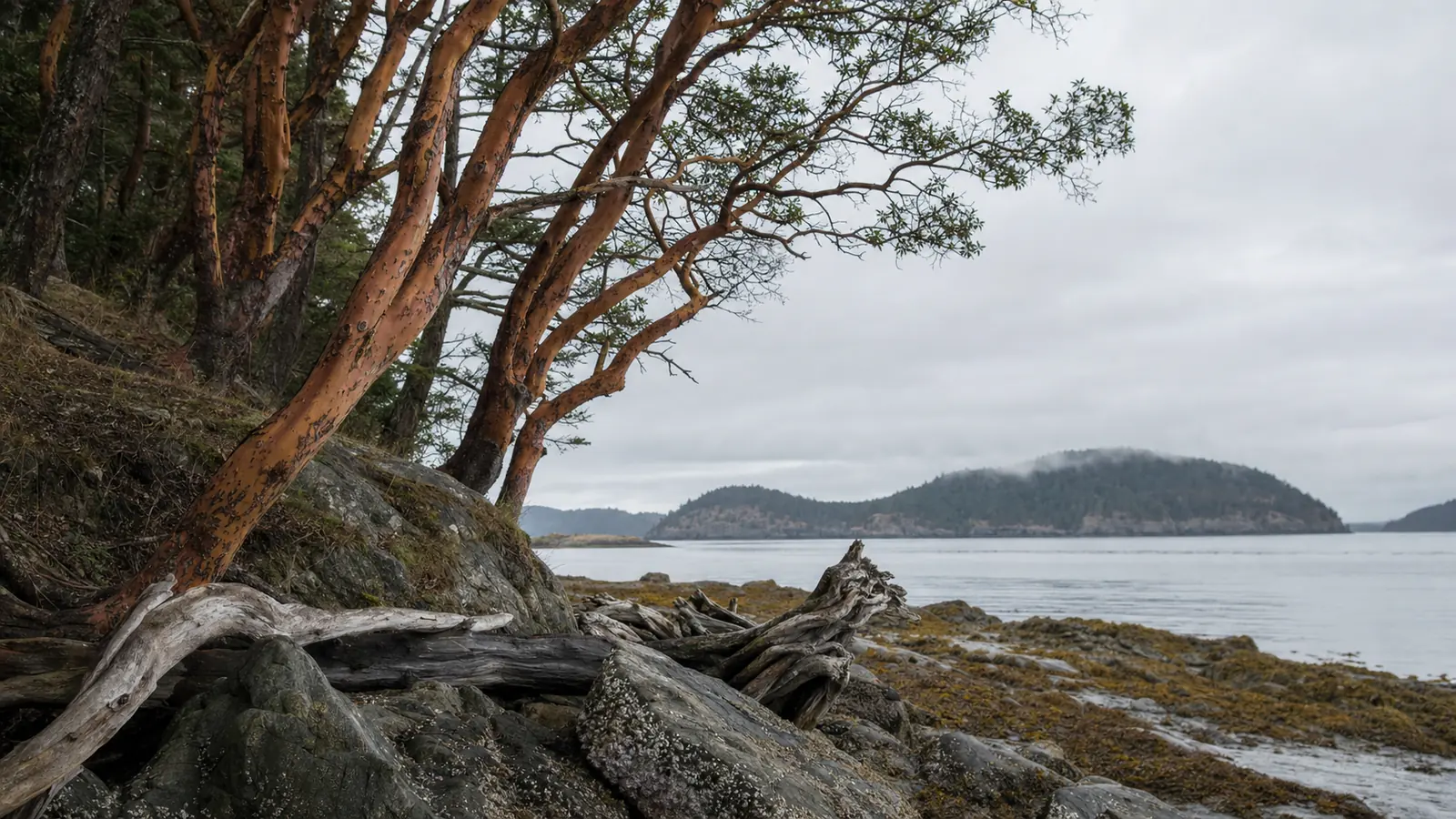
Rustic by design, and what that means for repairs
Johns has no utility electricity and no municipal water or sewer. The cabins are simple wood buildings, many of them decades old, built and extended by their owners, heated by wood, and served by whatever water and power each place has arranged for itself. That is the island's character and people choose it deliberately.
It also sets the shape of the work. I bring battery tools with spare packs charged at home and I do not assume there is anything to plug into. I plan for no running water on site. I bring my own light. Everything that comes off the job leaves in the boat with me.
The failures on a rustic cabin left empty for nine or ten months of the year are consistent and predictable. Cedar shakes and board siding at the weather corner go past due and start letting water into the sheathing. Roof moss builds on the shaded slope and lifts the shingle edges. Deck boards and stair treads soften at the ends where they meet the framing. Doors and window sashes swell in a cabin with no heat, so by spring nothing latches and one window will not open at all. Screens tear and stay torn. And in an unheated wood building on an outer island, rodents get into the crawlspace or the floor structure — not occasionally, routinely — and the way you find out is either a spring visit or a smell.
Most of what I am actually useful for on Johns is door, window, and trim work and small structural carpentry on decks and stairs, plus closing the gaps that let animals in.
Fifty-three cabins, three occupied
Johns is the most extreme example of the pattern that runs through this whole part of the county. The San Juan County comprehensive plan appendix counts 53 dwelling units against 3 occupied year-round, with an island population of about 6. Those are planning figures — 2000 census occupancy, 2005 unit counts — and the most recent per-island numbers the county publishes, not a current count. Even allowing for their age, the ratio is stark: essentially the entire island is closed for most of the year.
There is nobody on Johns to notice a problem in January. No caretaker walking the lanes, no neighbor with a light on, no marina staff. An empty cabin with a lifted shingle in November is an empty cabin with a wet ceiling in March, and the first anyone knows about it is when the owner arrives in summer.
So on Johns I would rather sell home watch than repairs. A visit at the front and back of winter — walk the exterior, check for animal entry, clear the roof and gutters, confirm the building is closed up properly, photograph anything that changed — is the highest-value thing anyone can do for a cabin out here. Repairs found early are skiff-scale. Repairs found late are barge-scale.
Skiff-scale only, and I mean it
My boat is a 16-foot skiff. It carries me, my tools, and small materials, and 20 feet is the honest ceiling on board length. On Johns that limit bites harder than anywhere else on this list, because there is no marina, no ramp beside the work, and no cart infrastructure to rely on — it is a beach or a private dock and then a carry. Realistically I can bring hardware, fasteners, trim, a few boards, shake or shingle material for a patch, paint, screen stock, and a day's tools. Anything at project scale needs a landing craft, and on Johns that is a genuine piece of planning around tide and beach. If your job is that size, I will say so on the phone and help you line up freight instead of quietly failing at it.
Questions I get about Johns
Do you work for Camp Nor'wester?
No. I work for private cabin owners on the east end of Johns Island. The camp on the west end is not a client.
There is no power at my cabin. Is that a problem?
No. Johns has no utility electricity, so I plan for it: battery tools, spare packs charged at home, my own lighting, and no assumption of running water on site.
What do you need to know before booking a Johns day?
Exactly where I land — private dock or beach — what the approach is like at that state of tide, and how far the carry is to the cabin. That determines what can realistically get done.
Next step
Work waiting on Johns?
Send me the list and where I land, and I’ll quote the boat day before anything is booked. Call (360) 317-0203.
Related