Handyman and Property Care on Waldron Island
Waldron is the one outer island that is genuinely a year-round community, and it is off the grid on purpose. I work there quietly and on the island's terms.
- Licensed & bonded
- WA L&I #SANJUJI741OT
- Insured
- Locally owned in Friday Harbor
One dock, no stores, no grid
Waldron has a single county-owned dock, at Cowlitz Bay on the southwest side. That is the landing. There is no ferry, no marina, no fuel, and no store — the last one closed in 1942. Public land on the island amounts to the county road and the dock, plus the preservation trust's Cowlitz Bay Preserve shoreline. Everything else is private, and residents are used to that being understood.
From Friday Harbor it is roughly ten nautical miles up through San Juan Channel and across President Channel, so figure a good part of an hour, weather allowing. President Channel is open water with a real fetch when it blows from the south, and Waldron is the island on this list I am most likely to postpone. If I say the crossing does not look right, that is not me being careful with your schedule — it is a 16-foot boat.
There is also no public power, no public water, and no sewer system on Waldron. Households run wells, solar, wind, and generators. Practically that changes how I work: I bring battery tools charged at home, a spare set of batteries, and I do not assume there is an outlet at the house. I pack my waste and offcuts back out in the boat.
A real community, not a resort
Waldron has been a state-designated limited development district since 1976, written into county code as its own subarea plan. Large homes are not built there, roads are not paved, commercial recreation is prohibited, and the island has consistently held fewer than a hundred full-time residents. There is a K-8 schoolhouse operating under the Orcas Island district, which the state classifies as remote and necessary, a post office, and a cemetery. There is no commercial tourism and the residents would like to keep it that way.
I mention all of this because it changes how a tradesperson should behave there. I do not solicit door to door on Waldron. I do not put a truck sign on a golf cart. I come because a specific owner asked me to come, I do that person's work, and I leave. Fourth-generation homesteaders and long-time off-grid households do not need a contractor treating their island as a market.
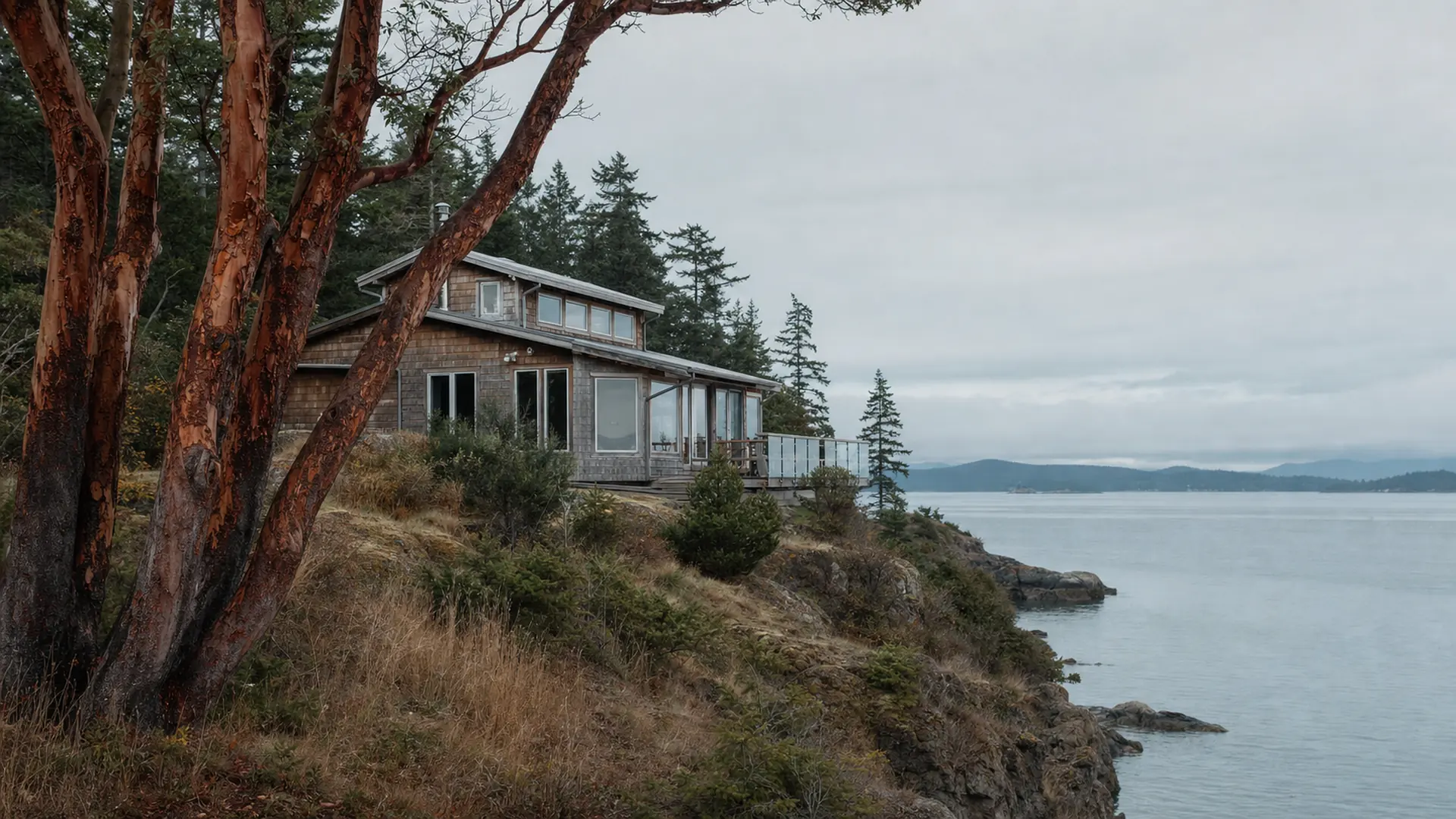
It also means the work itself is different. Waldron houses are mostly modest, wood, hand-built or owner-extended over decades, heated with wood, and maintained by people who are good with their hands. Nobody on Waldron is calling me to hang a picture. What I get asked for is the thing that needs two people, or a tool nobody on the island happens to own, or a repair that has been on the list for three years: a door that no longer closes against a racked jamb, sill and casing rot at a south wall, deck framing that has gone soft at a post base, siding and trim repair where the weather got in.
Sixty-two occupied houses, and a hundred and eighty-nine of them
Waldron is the exception to the seasonal-vacancy pattern that defines the rest of the outer islands. The San Juan County comprehensive plan appendix lists 189 dwelling units against 62 occupied year-round — by far the most genuinely lived-in of the non-ferry islands, though still two-thirds seasonal. As with the rest of that table, the occupancy figure is 2000 census and the unit count is 2005; they are planning numbers and the most recent per-island public data, not a current census.
For the seasonal side of Waldron, property care matters for a specific reason: an off-grid house left alone has more to go wrong than a grid-tied one. Battery banks and generator sheds sit idle. Rain catchment and gutter systems here are functional infrastructure rather than trim detail, so a blocked downspout is not a cosmetic problem. Rodents find the crawlspace of an empty wood house on a rural island quickly, and they find it in October. A scheduled walk-through, with photographs and a written note of what I saw, is worth more here than almost anywhere else in the county.
For the year-round side, the useful thing I offer is a boat day that several households can share. If three people on Waldron have a list, one crossing covers all three and everybody's share of the travel drops. That is how I would rather work the island, and it is the arrangement Waldron neighbors are already good at organizing among themselves.
What fits in the boat
My boat is a 16-foot skiff. It carries me, my tools, and small materials, and 20 feet is the honest ceiling on board length. For Waldron that means repair-scale material: trim, framing lumber in small quantities, a door slab, hardware, fasteners, roofing patch material, paint, screen. Anything at building scale — a lumber package, sheet goods, roofing in quantity, appliances, or debris going off the island in volume — needs a barge or a landing craft, and Cowlitz Bay is where that gets arranged. I will help you sort out the freight and schedule my day around when it lands, rather than trying to shuttle it in a skiff.
Questions I get about Waldron
Is there power at the house for your tools?
I assume not. Waldron has no public electricity, so I bring battery tools and spare batteries charged at home and plan the day around that.
How likely is a Waldron trip to get postponed?
More likely than anywhere else I go. The crossing includes open water in President Channel, and in a 16-foot boat I will move the date rather than push it.
Do you advertise or solicit on the island?
No. I come when a specific owner asks me to come, do that work, and leave. Waldron residents are protective of the island and that is reasonable.
Next step
Work waiting on Waldron?
Send me the list and where I land, and I’ll quote the boat day before anything is booked. Call (360) 317-0203.
Related